How to Safely Purchase Bulk Email Accounts for Effective Mass Email Marketing from Trusted Wholesale Providers
Most email marketing campaigns don't fail because of poor copywriting or weak offers - they fail because the sending infrastructure can't support the volume required to generate meaningful results. A single email account sending a few dozen messages per day is not a marketing channel; it's a bottleneck dressed up as one. Marketers who want to run serious outreach operations quickly discover that scaling requires more than a better subject line. It requires a fundamentally different approach to account infrastructure.
That infrastructure starts with understanding how to responsibly acquire and manage accounts at scale. For those building or expanding a high-volume outreach operation, the decision to buy bulk email accounts from a verified wholesale source is often the logical next step - but it's a step that rewards careful planning and punishes shortcuts. The difference between a reliable bulk email account service and a low-quality vendor is not always visible upfront, and the consequences of choosing poorly tend to surface at the worst possible moment: mid-campaign, when accounts start dropping and deliverability collapses.
This guide covers every decision point in the process - from understanding what types of accounts exist and why they behave differently, to evaluating wholesale providers, structuring purchases, warming up accounts correctly, and staying compliant with the legal frameworks that govern commercial email. The goal is to give you a complete, practical picture so that your investment in bulk email marketing accounts translates into actual campaign performance rather than operational headaches.
What Are Bulk Email Accounts and Why Marketers Need Them
A bulk email account is an email address - hosted on platforms like Gmail, Outlook, Yahoo, or a custom domain - that is acquired in volume and used specifically for outbound marketing, cold outreach, or automated email sequences. The defining characteristic is not the platform or the email address format; it's the operational logic behind acquiring and deploying many accounts simultaneously to distribute sending load across multiple senders.
Email platforms impose sending limits on individual accounts for legitimate anti-spam reasons. When a single account consistently sends hundreds of messages per day, algorithms flag the behavior as suspicious, throttle delivery, or suspend the account entirely. Distributing the same total send volume across dozens of properly managed accounts - each operating within platform norms - allows marketers to reach large audiences without triggering these defenses. This is the core rationale behind buying multiple email accounts for marketing use.
Beyond raw volume, account diversification also protects campaign continuity. If one account gets suspended, the remaining accounts in your rotation keep the campaign running while the issue is resolved. Marketers who depend on a single account or domain for all outreach have no fallback when problems occur - and problems always occur eventually in high-volume operations.
Types of Email Accounts Available in Bulk
Not all accounts serve the same purpose, and choosing the wrong type for your campaign is a common and avoidable mistake. The major platforms each have distinct characteristics that affect deliverability, recipient trust, and integration capability.
Gmail accounts consistently earn the highest trust ratings among recipients and spam filters alike. For B2B cold outreach, where personalization and sender credibility matter, Gmail-based accounts perform well. They also integrate cleanly with most outreach automation tools. The tradeoff is that Gmail applies stricter behavioral monitoring than some other platforms, making proper warm-up especially important.
Outlook and Hotmail accounts are widely used in business outreach contexts and integrate naturally with Microsoft-based sales and productivity tools. Their deliverability profile is solid for B2B scenarios, and many enterprises are more likely to engage with messages arriving from an Outlook address than from less familiar providers.
Yahoo accounts have historically been used in high-volume campaigns due to their relatively accessible sending behavior, though their deliverability to professional inboxes can be inconsistent depending on campaign setup. Custom domain accounts - built on domains purchased and configured specifically for outreach - offer the greatest control over sending reputation and technical authentication but require more setup work upfront.
- Gmail accounts: high recipient trust, strong B2B deliverability, strict behavioral monitoring
- Outlook and Hotmail accounts: solid for business outreach, integrates with Microsoft tooling
- Yahoo accounts: widely used for volume campaigns, variable deliverability to professional inboxes
- Custom domain accounts: maximum control over reputation and authentication, requires DNS configuration
- Aged accounts: established creation history, higher trust signals, premium pricing
- Fresh accounts: newly created, lower cost, require a full warm-up period before deployment
Common Use Cases for Buying Multiple Email Accounts
The range of professionals who rely on bulk email marketing accounts is broader than many assume. Cold outreach is the most visible application - sending personalized initial contact messages to prospects who have never interacted with your brand. Because cold outreach is volume-dependent by nature, distributing sends across many accounts allows teams to contact large prospect lists weekly without overloading any individual sender or triggering spam filters.
Agencies running outreach on behalf of multiple clients face a structural need for account separation. Mixing client campaigns through shared accounts creates attribution problems and increases the risk that one client's poor-performing campaign damages the sending reputation used by others. Separate account batches per client is standard operational hygiene in professional outreach agencies.
A/B testing at scale is another high-value use case. Testing subject lines, sender names, or email formats across many accounts simultaneously generates statistically meaningful data far faster than a single-account operation would allow. E-commerce teams, affiliate marketers, and SaaS growth teams all use similar logic when running promotional sequences across segmented lists.
- Cold outreach and lead generation across large prospect databases
- Affiliate marketing email sequences distributed across multiple senders
- Agency client campaign separation and deliverability isolation
- A/B testing of sender identity, subject lines, and email content
- Business continuity - backup accounts ready when active ones are suspended
- Domain reputation segmentation by campaign type or audience segment
How to Identify Trusted Wholesale Email Account Providers
The market for bulk email account services attracts a wide range of vendors - from professional, well-structured suppliers to opportunistic operations selling low-quality accounts with no support and no accountability. The challenge is that the surface presentation of many vendors looks similar. A clean website, competitive pricing, and confident product descriptions don't reliably distinguish a reputable wholesale email account provider from one that will leave you with suspended accounts and no recourse.
Trustworthy providers share a set of observable, verifiable characteristics. They explain their account creation methods clearly, disclose what verification processes are used, describe expected account lifespans honestly, and provide defined replacement or refund policies in writing. When you ask specific technical questions - about the IP addresses used during account creation, whether accounts are phone-verified, or whether recovery options are included - they give specific answers. Vague responses to precise questions are a reliable signal that the vendor either doesn't know or doesn't want you to know.
Reputation in the practitioner community also matters. Experienced marketers who purchase mass email accounts regularly tend to discuss provider quality openly in outreach-focused forums and professional communities. A provider with a consistent record of positive reviews from people who have actually used the accounts in live campaigns carries far more credibility than one with polished marketing copy and no independent validation.
Key Quality Indicators to Evaluate Before You Buy
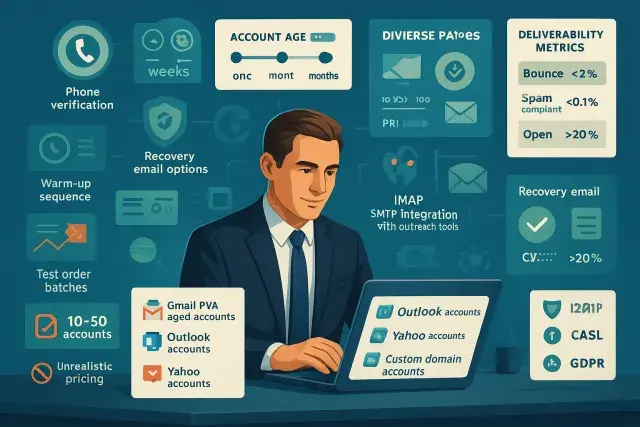
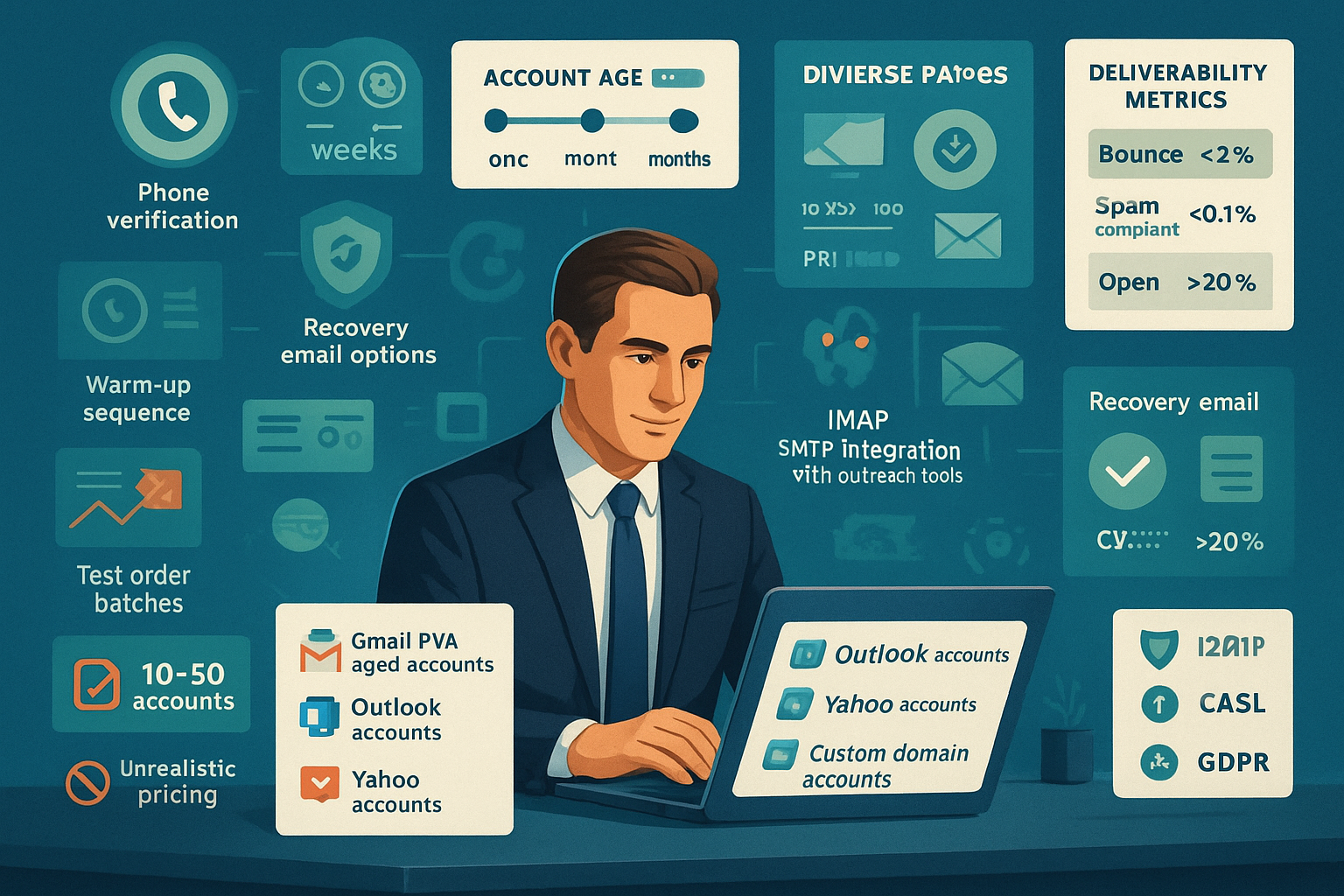
Several technical variables directly predict how well purchased accounts will perform in actual campaigns. Phone verification is the most important of these. Accounts verified with unique real phone numbers at the time of creation carry a measurably higher trust signal with email platform algorithms. Phone-verified accounts (commonly referred to as PVA accounts) are significantly less likely to be flagged or suspended immediately upon activation, particularly when they're being used for the first time by a new operator.
Account age is the second critical variable. An account created months before purchase has an established behavioral history - it looks to platform algorithms like an account belonging to a real person who has been using it over time. Freshly created accounts lack this history and require a careful warm-up period to build it. Skipping warm-up on fresh accounts is one of the leading causes of mass suspension events, regardless of how reputable the provider is.
IP diversity at account creation matters because platforms monitor the creation patterns of accounts registered from the same IP addresses. A batch of accounts created from identical or closely related IPs is much more likely to be treated as a coordinated automation artifact and flagged or suspended in bulk. Quality providers create accounts across diverse IP environments to avoid this pattern.
| Quality Factor | What to Look For | Why It Matters | Risk if Absent |
|---|---|---|---|
| Phone Verification | Unique real phone number per account | Higher platform trust score from creation | Early suspension after activation |
| Account Age | Accounts created weeks or months before sale | Established behavioral history reduces risk | Shorter lifespan, faster degradation |
| IP Diversity at Creation | Different IP environments used per account | Prevents pattern-based bulk detection | Entire batch flagged simultaneously |
| Recovery Options | Backup email or recovery phone included | Account can be recovered if locked out | Permanent access loss on lockout |
| Replacement Guarantee | Defined policy with clear replacement window | Financial protection on defective accounts | Full loss on bad batches with no recourse |
| Delivery Format | Organized credential files, clear structure | Faster onboarding and reduced setup errors | Operational delays and misconfigurations |
Red Flags and Warning Signs in the Provider Market
Pricing is one of the most reliable early indicators of account quality. Bulk accounts sold at a significant discount compared to market averages are almost always produced through heavily automated creation methods using synthetic registration data. These accounts tend to have very short lifespans - often failing within days of deployment - and the apparent savings disappear quickly when you factor in the replacement cost and the campaign downtime.
Providers who cannot or will not answer technical questions clearly are another category to avoid. A professional-grade wholesale operation understands its own product. If a vendor can't explain what verification method was used, what IP sourcing approach was applied, or whether accounts include recovery options, that's not a supplier you can build a sustainable operation around.
Unrealistic performance promises are also worth scrutinizing. No legitimate provider can guarantee that accounts will never be suspended - that outcome depends heavily on how the accounts are used, warmed up, and managed after purchase. Any vendor promising "unlimited sending" from day one or guaranteeing permanent account stability is either uninformed or deliberately misleading.
- Prices significantly below established market averages
- No published or clearly stated replacement or refund policy
- Vague or evasive answers to specific technical questions
- No verifiable independent reviews or community reputation
- No information on verification method or IP sourcing
- No customer support channel or delayed response to inquiries
- Accounts delivered in unstructured or incomplete credential formats
- Promises of immediate high-volume sending with no warm-up requirement
Evaluating Pricing, Volume Options, and Provider Reliability
Once you've identified providers that meet basic quality thresholds, the comparison shifts to pricing structure, available volume tiers, delivery timelines, and the kind of reliability that sustains a long-term supplier relationship. For marketers who need a consistent supply of bulk email marketing accounts to keep campaigns running, the provider relationship is ongoing - which means evaluating reliability matters as much as evaluating the accounts themselves.
Pricing in this market reflects a fairly consistent logic: higher trust, older accounts on high-reputation platforms cost more per unit. Gmail PVA accounts consistently command the highest prices. Outlook accounts occupy a middle tier. Accounts on lower-profile platforms are more affordable but may not suit all outreach contexts. Volume discounts are standard - per-account cost drops as order size increases - and understanding those tiers helps you plan purchases strategically rather than buying reactively.
Understanding Pricing Tiers and Volume Discounts
Approaching bulk account purchasing with a clear volume plan prevents both over-purchasing and the operational risk of running out of accounts mid-campaign. Most providers structure pricing in brackets - orders under a certain quantity pay a base rate, while larger orders unlock progressively lower per-unit pricing. The exact thresholds vary by provider and account type, but the structure itself is consistent across the market.
Testing a new provider with a smaller initial order before committing to large quantities is standard practice and financially prudent. The quality difference between providers is rarely visible from their websites alone - it becomes apparent when you actually log into the accounts, test sending behavior, and observe how long accounts remain active under realistic usage patterns.
| Account Type | Typical Price Range (per account) | Verification Level | Expected Lifespan | Best Use Case |
|---|---|---|---|---|
| Gmail PVA (fresh) | $0.50 - $1.50 | Phone verified | Medium with proper warm-up | B2B cold outreach, personalized sequences |
| Gmail PVA (aged) | $1.50 - $4.00 | Phone verified and aged | High | High-value outreach, agency client campaigns |
| Outlook / Hotmail | $0.30 - $1.20 | Phone or email verified | Medium | Business outreach, Microsoft tool integration |
| Yahoo | $0.20 - $0.80 | Email verified | Low to medium | High-volume campaigns with broad targeting |
| Custom domain | $2.00 - $10.00+ | Domain-configured with DNS | High with correct setup | Agency branding, advanced sender authentication |
Assessing Provider Reliability for Long-Term Partnerships
A provider who delivers a clean first batch but can't maintain quality or availability over time is not a reliable operational partner. Long-term reliability shows up in several ways: consistent stock levels across preferred account types, accurate and timely order fulfillment even for larger quantities, responsive support when account issues arise, and transparent communication if sourcing or quality conditions change.
Independent reviews from marketers who regularly buy multiple email accounts for active campaigns are the most useful signal available. Marketing communities and outreach-focused professional networks frequently surface detailed, experience-based assessments of specific providers - covering account longevity, replacement policy responsiveness, and whether quality has shifted over time. This ground-level feedback is harder to find than a provider's own testimonials but far more reliable.
- Consistent stock availability across account types and quantities
- Accurate order fulfillment with clear delivery timelines
- Responsive customer support that resolves issues efficiently
- Transparent communication about product changes or quality shifts
- Positive track record in independent marketing communities
- Operational history that predates your first purchase - not a new vendor
Step-by-Step Process for Safely Purchasing Bulk Email Accounts
Even with a reputable provider identified and pricing evaluated, the actual purchasing process rewards a methodical approach. Rushing into a large order without testing the provider first is a mistake that experienced marketers rarely make twice. A structured purchase process protects your investment, establishes a quality baseline, and creates the documentation needed to resolve disputes if problems arise.
Pre-Purchase Checklist and Test Order Strategy
A test order - typically between 10 and 50 accounts - should precede any significant commitment with a new provider. This is not about distrust; it's about verification. A test order gives you concrete information about delivery format, credential accuracy, account accessibility, initial login behavior, and how the provider responds when you report issues. That information is worth far more than the cost of a small test batch.
Before placing even the test order, confirm the provider's replacement policy in writing. Know the window during which defective accounts are eligible for replacement, what documentation they require, and how quickly replacements are typically delivered. These details matter when accounts fail - which some percentage always will, even from quality suppliers.
- Define your account type requirements: platform, verification level, age preference
- Shortlist two or three candidate providers based on research and community reputation
- Review each provider's replacement policy, delivery terms, and support channels
- Place a test order of 10 to 50 accounts with your highest-ranked candidate
- Verify account accessibility and confirm credential accuracy upon delivery
- Log into a representative sample and observe initial platform behavior
- Contact the provider with any issues and evaluate their response quality and speed
- Confirm that account quality meets stated specifications before scaling the order
Secure Payment and Transaction Best Practices
Payment method choice carries real risk implications when purchasing from an unfamiliar vendor. Using a payment method that offers dispute resolution - such as a credit card or an established digital payment platform - provides financial recourse if a provider fails to deliver as described. For first-time orders with vendors you haven't verified, avoiding payment methods that are irreversible upon completion is a practical precaution, not an overreaction.
Documentation matters more than most buyers anticipate. Keep records of every transaction: order confirmations, account delivery files, and all communication with the provider regarding quality, replacements, or billing. This documentation is essential for dispute resolution and also helps you track per-account costs accurately over time - which informs smarter purchasing decisions as your operation scales.
- Use payment methods with dispute resolution for orders from new providers
- Retain order confirmations and delivery receipts for every transaction
- Document all provider communications about quality or replacement claims
- Use dedicated purchase accounts separate from primary business credentials
- Avoid sharing unnecessary personal or business information beyond what the transaction requires
Setting Up and Managing Purchased Accounts for Maximum Deliverability
Purchasing accounts from a quality provider solves only half the problem. How those accounts are configured, warmed up, and managed after delivery determines whether your campaign infrastructure performs reliably or deteriorates within weeks. Many marketers who purchase mass email accounts and then experience early suspension events made no errors in the purchasing process itself - the problem was in the setup and deployment phase that followed.
Account Warm-Up: Why It's Non-Negotiable
Email platform algorithms continuously monitor sending behavior. An account that suddenly begins sending dozens or hundreds of messages per day - particularly to unfamiliar recipients with no prior engagement history - triggers algorithmic flags that typically result in sending restrictions or account suspension. Warm-up is the process of gradually building a realistic sending history that trains the algorithm to treat the account as a legitimate, human-operated sender.
Warm-up applies to all fresh accounts without exception. Even aged accounts benefit from a structured ramp-up when operated by a new user, since a sudden change in access location or sending pattern can still attract scrutiny. The warm-up process combines outbound sends at gradually increasing volumes with genuine two-way engagement - receiving and replying to emails - to establish a behavioral profile that looks organic.
- Log in and configure each account with a realistic sender name and profile
- Begin with five to ten outbound emails per day per account
- Include genuine two-way email exchanges throughout the warm-up period
- Increase daily send volume by approximately 20 to 30 percent every three to five days
- Monitor each account for platform warnings, CAPTCHA prompts, or unusual login challenges
- Use dedicated warm-up tools to automate the process and track deliverability scores across batches
- Do not begin campaign-level sends until each account reaches target volume without triggering restrictions
Technical Configuration for Campaign Readiness
Beyond warm-up, proper technical configuration ensures that accounts integrate correctly with your outreach tools and that basic authentication signals are in place. For custom domain accounts, configuring SPF, DKIM, and DMARC records is a prerequisite, not an optional enhancement. These DNS-based authentication protocols verify sender identity to receiving mail servers and directly influence inbox placement rates. Campaigns sent from domains without proper authentication consistently underperform those with full authentication configured.
For accounts on major platforms, enabling IMAP and SMTP access allows integration with outreach automation platforms and CRM tools. Two-factor authentication should be configured with a recoverable backup method - one you control and can access if the primary login method becomes unavailable. Organizing accounts into logical groups by campaign, audience segment, or sending rotation simplifies management as your portfolio scales and reduces the operational complexity of monitoring multiple accounts simultaneously.
- Enable IMAP and SMTP access for integration with outreach and automation tools
- Configure SPF, DKIM, and DMARC records for all custom domain accounts
- Set up two-factor authentication with a recoverable backup method you control
- Organize accounts into campaign-specific groups for easier management and rotation
- Store credentials and configuration details securely using a password manager or similar tool
- Test SMTP connectivity for each account before deploying it in any live campaign
Ongoing Account Monitoring and Rotation Strategy
Even well-configured, properly warmed accounts accumulate sending risk over time. High-volume outreach campaigns generate spam complaints, bounce events, and unsubscribe signals that gradually erode sender reputation at the account level. A rotation strategy - cycling accounts in and out of active use - distributes this wear across a larger pool, reducing the load on any individual account and extending the operational lifespan of the entire batch.
Monitoring key metrics at the account level - not just the campaign level - allows early identification of accounts showing signs of deliverability decline. An account whose emails are increasingly landing in spam folders, accumulating high bounce rates, or generating elevated complaint rates should be rested or retired before those signals compound into full suspension. Proactive account management preserves the health of your recipient lists and prevents reputation contamination from spreading across your sending infrastructure.
| Metric | Healthy Threshold | Warning Level | Recommended Action |
|---|---|---|---|
| Bounce Rate | Below 2% | 2% - 5% | Clean the list, reduce send volume |
| Spam Complaint Rate | Below 0.1% | 0.1% - 0.3% | Review email content, pause account temporarily |
| Open Rate | Above 20% | 10% - 20% | Check inbox placement, test subject line variations |
| Reply Rate | Above 3% | Below 1% | Revisit targeting criteria and message relevance |
| Account Suspensions per Batch | Zero | One or two per batch | Review warm-up process and daily send limits |
Legal Considerations and Compliance When Using Bulk Email Marketing Accounts
Operating a bulk email infrastructure without a working understanding of applicable legal requirements is not just risky - it's operationally unsustainable. Regulatory exposure in email marketing is real, and the consequences of non-compliance - including fines, blacklisting, and reputational damage - typically outweigh whatever short-term campaign gains an uncompliant approach might generate. Legal compliance is also a prerequisite for maintaining deliverability over time, since platform abuse teams increasingly coordinate with regulatory bodies in major markets.
The core legal frameworks governing commercial email include the CAN-SPAM Act in the United States, the General Data Protection Regulation in the European Union, and the Canadian Anti-Spam Legislation. Each framework establishes distinct rules around consent, sender identification, data handling, and opt-out requirements. Critically, the applicable framework is typically determined by the location of the recipient, not the location of the sender - which means marketers sending internationally must understand the rules in every jurisdiction their campaigns reach.
Consent, Opt-Out, and Data Handling Requirements
The most consequential legal variable in bulk outreach is consent. Regulations differ on whether prior consent is required before sending commercial email. Under GDPR, explicit opt-in consent is generally required for marketing communications. CAN-SPAM, by contrast, permits unsolicited commercial email under specific conditions - including accurate sender identification, a physical mailing address, and a functional opt-out mechanism - but does not require prior consent. CASL requires express or implied consent before sending commercial electronic messages to Canadian recipients.
Regardless of which framework applies, every commercial email must include a clear and functional unsubscribe mechanism, and opt-out requests must be processed promptly. Maintaining suppression lists - records of contacts who have opted out - and applying those lists consistently across all accounts in your bulk infrastructure prevents accidental re-contact, which carries significant legal exposure in most jurisdictions.
- Identify which legal frameworks apply based on recipient geography
- Include a clear, functional unsubscribe link in every commercial email
- Honor opt-out requests within the timeframe required by applicable law
- Maintain suppression lists and apply them across all accounts in your rotation
- Include accurate sender identification - name and physical address - in every message
- Avoid misleading subject lines or deceptive sender name formatting
- Review platform terms of service in addition to legal compliance requirements
Platform Terms of Service and Account Stability
Legal compliance and platform policy compliance are related but distinct. Email platforms enforce their own terms of service independently of national regulations, and violations of those terms - regardless of legal status - result in account suspension or permanent bans. Understanding what each platform permits in terms of account creation, access methods, and sending patterns is part of the operational knowledge required to run sustainable bulk email campaigns.
This is where the quality of your wholesale provider intersects directly with your compliance posture. Providers who are transparent about how accounts are created and who offer guidance on how to use accounts within platform norms are demonstrably more trustworthy than those who ignore these dimensions entirely. Providers who actively encourage obviously prohibited behaviors - bypassing security measures, spoofing identities, or ignoring sending thresholds - are not compatible with a sustainable long-term operation. The cost of replacing constantly suspended accounts will always exceed the cost of doing things properly from the start.
Questions and Answers
What is the practical difference between a phone-verified account and a standard bulk account?
A phone-verified account was confirmed with a real, unique phone number during registration, which creates a stronger trust signal in the platform's authentication system. Standard accounts verified only by email address or with minimal verification carry lower trust scores and are more likely to trigger security challenges or suspension shortly after activation. For outreach campaigns where account longevity matters, the price premium on phone-verified accounts is typically justified by significantly better lifespan outcomes.
How many accounts should I start with when testing a new wholesale provider?
A test batch of 10 to 50 accounts gives you enough material to evaluate credential accuracy, account accessibility, delivery format, and provider responsiveness without significant financial exposure. Log into a cross-section of accounts, attempt basic operations, and contact support with any defective accounts within the replacement window. Only scale to larger orders once the test batch confirms the provider meets your quality standards in practice, not just on paper.
Can I use purchased bulk email accounts with third-party outreach automation tools?
Yes, most bulk accounts can be connected to outreach platforms and automation tools via IMAP and SMTP credentials. Before setup, confirm that IMAP and SMTP access is enabled in each account's settings, and test the connection before deploying accounts in live campaigns. Custom domain accounts generally offer the cleanest integration experience and the most control over sender authentication, which improves deliverability when configured correctly.
What should I do when a purchased account gets suspended during a campaign?
First, remove the suspended account from your active rotation immediately to prevent further send attempts. Then contact the provider within their stated replacement window with documentation - login credentials, the platform where the suspension occurred, and any platform error messages received. If the suspension was caused by your sending behavior rather than account quality, adjust your warm-up process and daily volume limits before redeploying replacements. Always maintain a reserve pool of warmed accounts so that individual suspensions don't halt campaign momentum.
Is aged account pricing worth the additional cost compared to fresh accounts?
For high-stakes outreach where deliverability and sender credibility directly affect campaign ROI - such as agency client campaigns, enterprise prospecting, or time-sensitive launches - aged accounts typically justify their premium. They carry an established behavioral history that reduces early suspension risk and often produces better inbox placement from the outset. For lower-stakes volume campaigns where replacement cost is manageable and warm-up time is available, fresh phone-verified accounts can be a cost-effective alternative when managed carefully.
What are the most common reasons bulk email accounts fail prematurely?
The most frequent causes are skipping or rushing the warm-up period, sending at volumes that exceed realistic single-account behavior, using low-quality accounts created through automation with synthetic registration data, and sending content that generates high spam complaint rates. Accounts purchased from providers who use shared or easily detectable IP patterns during creation are also prone to batch-level suspension. Addressing these factors - through proper warm-up, realistic daily send limits, quality account sourcing, and content that recipients genuinely want - eliminates most premature account failures.